
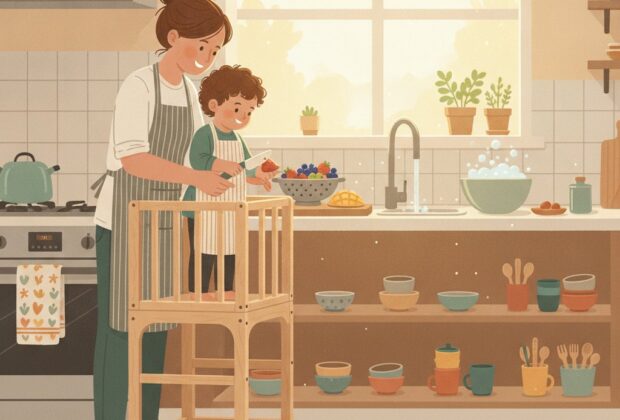
Why the Kitchen Is a Powerful Montessori Space
The kitchen is one of the richest environments for early childhood learning. It combines sensory experiences, fine motor development, sequencing, and real-world purpose in a single space. In Montessori philosophy, children are naturally drawn to meaningful work, and few activities feel more meaningful to a young child than helping prepare food that the whole family will eat. Designing a Montessori kitchen for kids is not about buying a miniature play kitchen set — it's about making the real kitchen accessible and safe enough for genuine participation.
This approach builds on the broader principles of creating an independence-friendly home, and pairs naturally with other spaces designed for autonomy, such as a thoughtfully arranged bedroom. If you haven't yet explored how these principles apply room by room, our guide Montessori at Home: Full Guide to Independence offers a helpful starting point, while Montessori Bedroom Setup for Toddlers covers how the same philosophy translates to sleep and dressing routines.
The Learning Tower: A Cornerstone of Kitchen Independence
A learning tower is a sturdy, elevated platform that allows a toddler to safely stand at counter height alongside an adult. Unlike a standard step stool, a learning tower has guardrails on multiple sides, preventing falls while giving children a stable, comfortable place to observe and participate in food preparation.
When choosing or building a learning tower, look for:
- Adjustable height settings that grow with your child over several years
- Enclosed railings on at least three sides for fall prevention
- A wide, stable base that won't tip even with active movement
- Non-slip flooring on the platform surface
Position the tower at your primary food-prep counter or sink so your child can be genuinely involved rather than simply watching from a distance. This small design choice transforms cooking time from a solo chore into a shared, teachable moment.
Creating an Accessible Kitchen Zone
Low Shelves and Drawers for Independent Access
To encourage true independence, children need to reach their own tools without asking for help every time. Dedicate one low drawer or open shelf near the child's work area to items they can use freely. This eliminates the need for constant adult intervention and reinforces the Montessori principle of the "prepared environment" — a space arranged specifically to support a child's developing capabilities.
Child-Sized Tools and Dishware
Equip this zone with tools sized appropriately for small hands:
- A child-safe knife made of wood or rounded plastic-edge design for cutting soft fruits and vegetables
- Small mixing bowls, whisks, and spatulas
- A short-handled brush and dustpan for spill cleanup
- Lightweight, unbreakable cups, plates, and pitchers stored within easy reach
- A small cutting board sized to a child's forearm length
Choosing real tools rather than toy replicas is essential. Montessori environments prioritize authentic materials because they respect the child's ability to handle genuine responsibility, and they produce real, satisfying results — a cut banana, a poured glass of water, a swept floor.
A Dedicated Pitcher and Water Station
One of the most popular Montessori kitchen features is a small pitcher station where children can pour their own water or juice. Use a small, lightweight pitcher filled only partway, placed on a tray with a cloth underneath to catch spills. This single addition builds concentration, coordination, and confidence, and it reduces the number of times a child needs to ask for a drink throughout the day.
Age-Appropriate Kitchen Tasks
Matching tasks to developmental stages ensures children experience success rather than frustration. Below is a general progression, though every child develops at their own pace.
Ages 18 Months to 2 Years
- Washing fruits and vegetables in a small basin
- Stirring pre-measured ingredients in a bowl
- Tearing lettuce or herbs by hand
- Placing napkins or utensils on the table
Ages 2 to 3 Years
- Pouring liquids from a small pitcher
- Cutting soft foods like bananas or cooked potatoes with a child-safe knife
- Spreading butter or hummus on bread
- Peeling hard-boiled eggs or citrus fruits
Ages 3 to 4 Years
- Cracking eggs into a bowl
- Measuring dry ingredients with child-sized cups
- Using a vegetable peeler with supervision
- Setting the full table independently
Ages 4 to 6 Years
- Following simple picture-based recipes
- Using a small serrated knife for firmer vegetables
- Operating a hand-crank mixer or grater
- Washing dishes at a low basin or sink
Introduce new tasks one at a time, demonstrating slowly and silently before inviting the child to try. This mirrors the classic Montessori "presentation" method used in classrooms, where the adult models each step deliberately so the child can absorb the sequence before attempting it independently.
Building Practical Life Skills Through Cooking
Montessori education places significant emphasis on "practical life" activities — everyday tasks that build coordination, order, concentration, and independence. The kitchen is arguably the richest source of these activities in the entire home.
When children participate in food preparation, they develop:
- Fine motor control through cutting, pouring, and stirring
- Sequencing skills by following multi-step processes from start to finish
- Sensory awareness through touching, smelling, and tasting ingredients
- Mathematical thinking via measuring and counting
- Language development through naming ingredients, tools, and actions
- Self-confidence from completing real, useful work
These benefits extend well beyond the kitchen itself. A child who has learned to carefully pour water without spilling, or to concentrate on cutting a banana into even slices, carries that same care and focus into other areas of life — much as a well-organized bedroom environment teaches similar lessons in dressing and self-care routines.
Safety Considerations for a Montessori Kitchen
Independence should never come at the expense of safety. Keep the following guidelines in mind:
- Always supervise young children near stoves, ovens, and sharp tools, even when using child-safe versions
- Store knives, matches, and cleaning chemicals in locked or entirely inaccessible locations, separate from the child-accessible zone
- Teach proper knife-holding technique explicitly before allowing independent cutting
- Use tempered glass or unbreakable dishware for the child's zone to minimize injury risk from accidental drops
- Establish clear boundaries around hot surfaces, explaining why certain areas are off-limits
Safety and independence work together rather than against each other. A well-designed Montessori kitchen anticipates risks and removes them from the child's reach, freeing the child to explore everything else with genuine freedom.
Setting Up on a Budget
A functional Montessori kitchen doesn't require an expensive renovation. Many families start with:
- A secondhand step stool modified with side rails, or a simple two-step stool for slightly older children
- Repurposed small bowls, cups, and utensils already in the kitchen
- A single low drawer cleared out and reorganized for child access
- A small basin placed inside the regular sink to lower the effective water level for washing hands or produce
Start small, observe how your child responds, and expand the setup gradually as their skills and interest grow.
Bringing It All Together
A Montessori kitchen for kids transforms an everyday household space into a hub of learning, connection, and confidence-building. By adding a learning tower, organizing an accessible zone with child-sized tools, and introducing tasks matched to your child's developmental stage, you give them the opportunity to contribute meaningfully to family life. These same principles of accessibility and respect for the child's capabilities apply throughout the home, from bedroom routines to broader independence-focused design choices, creating a consistent environment where children are trusted, capable, and eager to help.