
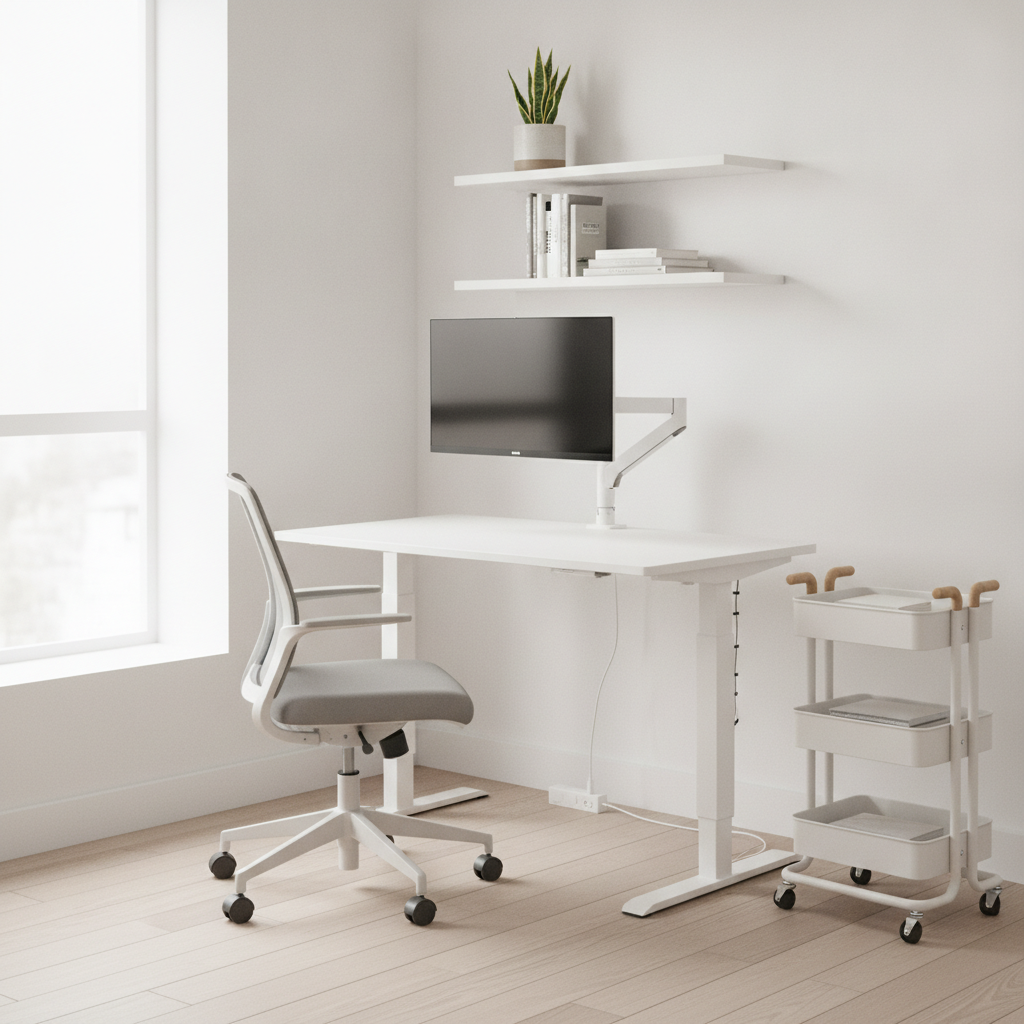
Fitting a standing desk into a small home office is less about square footage and more about smart planning. With the right layout strategy, even a 7x8 foot room can accommodate a comfortable sit-stand workstation without feeling cramped or blocking essential walkways. This guide walks through practical placement ideas, storage solutions, and cable management techniques designed specifically for tight spaces.
Start With Traffic Flow, Not the Desk
Before you decide where your standing desk goes, map out how you actually move through the room. Small offices often double as guest rooms, closets-turned-nooks, or corners of a bedroom, so the desk needs to coexist with doors, closets, and existing furniture. Walk the space and note where you naturally pass through several times a day.
A common mistake is placing the desk where it looks good on paper but ends up blocking a doorway or closet once it's raised to standing height. Because standing desks have a larger footprint when elevated (your body occupies more vertical space and you tend to shift and stretch), leave at least 30 inches of clearance behind the chair or standing position for movement.
Corner Placement: The Small Office MVP
Corner placement is almost always the best starting point for a small home office. Positioning the desk diagonally or flush against two walls frees up the center of the room for walking space and makes the layout feel less boxed-in. An L-shaped or compact rectangular standing desk tucked into a corner also gives you two walls to work with for shelving and cable routing.
If your room is particularly narrow, consider a desk under 40 inches wide, which slides neatly into corners without eating into circulation space. We cover specific models suited to this constraint in our guide to compact standing desks under 40 inches for tiny rooms.
Vertical Storage: Your Best Friend in a Small Room
When floor space is limited, the walls become your most valuable real estate. Wall-mounted shelving above and beside the desk keeps books, documents, and supplies off the surface and off the floor, which matters even more with a standing desk since you want an unobstructed area to move around when the desk height changes.
Floating Shelves and Pegboards
Install one or two floating shelves directly above the desk for frequently used items like notebooks, a printer, or a small plant. A pegboard mounted to the side wall is another excellent option, letting you hang cables, headphones, and small tools without consuming any desk or floor space. Both solutions keep the visual line of the room open, which makes a small office feel larger.
Under-Desk Storage That Doesn't Interfere With Height Adjustment
Standing desks move up and down, so any storage placed underneath needs to avoid interfering with the legs or crossbar mechanism. Slim rolling carts, narrow drawer units on casters, or a single stackable bin system work well because they can be tucked to one side and pulled out when needed. Avoid bulky filing cabinets that sit directly under the desktop, as they can restrict the lowest sitting height setting on many standing desks.
Monitor Arms: Reclaiming Desktop Space
One of the most effective upgrades for a small standing desk setup is a monitor arm. Freeing your monitor from a fixed stand not only improves ergonomics but also opens up several inches of desktop depth that would otherwise be occupied by a bulky base. This extra space matters in small offices where every inch of the desktop counts for notebooks, a keyboard tray, or a cup of coffee.
Look for a clamp-mount monitor arm that attaches to the back edge of the desk rather than a grommet-style mount, since clamps are easier to reposition if you rearrange the room later. For dual-monitor setups, a single dual-arm mount is more space-efficient than two separate stands and keeps cables tidier.
Cable Management for a Cleaner, Safer Setup
Cable clutter is especially noticeable in small rooms, where there's nowhere for tangled cords to hide. It's also a safety issue with standing desks, since cables need enough slack to accommodate the full range of height adjustment without snagging or pulling loose.
Practical Cable Routing Tips
- Use a cable management tray or basket mounted underneath the desktop to bundle cords in one place.
- Choose a spiral cable sleeve or velcro wraps for the section of cord that travels between the fixed desktop and the moving base, allowing it to flex smoothly.
- Mount a power strip to the underside of the desk or on a nearby wall stud rather than leaving it on the floor.
- Label cords at both ends if you frequently disconnect your laptop or peripherals, which speeds up daily setup and teardown.
Keeping cables off the floor also protects them from foot traffic, which is more likely in a small room where the desk sits closer to walkways.
Furniture Pairing for Tight Spaces
The chair and any secondary furniture you choose should complement the standing desk's footprint rather than compete with it. A compact task chair with a smaller base and armrests that tuck under the desktop when not in use is ideal. Avoid oversized executive chairs, which can make it harder to push the chair fully out of the way when you switch to standing.
If you need a place to sit occasionally for reading or calls, consider a small folding stool or a low-profile chair that can be stored against the wall rather than left in the open floor area. This keeps the room flexible and prevents the space from feeling permanently occupied by seating.
Before-and-After Layout Examples
Example 1: The Bedroom Corner Office
Before: A 60-inch desk placed against the longest wall, blocking half the closet door and leaving only 18 inches of walking space. After: The desk is swapped for a 40-inch corner-friendly model, angled into the room's corner, paired with a wall-mounted shelf and monitor arm. The closet is now fully accessible, and there's over 30 inches of clear floor space for standing and stretching.
Example 2: The Closet Nook Office
Before: A standard desk with a bulky filing cabinet underneath, preventing the lowest sitting height and leaving no room for a chair to tuck in. After: The filing cabinet is replaced with a slim rolling cart moved to the side, and a compact chair with a smaller base slides fully under the desktop when standing, freeing the nook's narrow walkway entirely.
Avoiding Common Pitfalls
Beyond blocking doors and closets, a few other issues come up repeatedly in small standing desk setups. Placing the desk too close to a heating vent or radiator can create comfort issues once you're standing at eye level with the heat source. Similarly, positioning the desk directly under a low sloped ceiling can limit how high you can raise it comfortably, so measure your maximum standing height needs against the ceiling clearance before finalizing placement.
Finally, resist the urge to fill every open wall with storage. Leaving at least one clear wall or sightline helps a small room feel breathable, even after you've added shelving, a monitor arm, and a compact desk. For a broader look at desk models built specifically for these constraints, see our complete guide to the best standing desks for small home offices in 2026.
Final Thoughts
A well-planned standing desk setup can make a small home office feel more functional, not more cramped. By prioritizing traffic flow, leaning on vertical storage, using a monitor arm to free up desktop space, and keeping cables tidy, you can create a workstation that adapts to your day without compromising the room's livability. Start with the corner placement strategy, layer in the storage tips above, and adjust based on how you actually use the space over the first few weeks.