
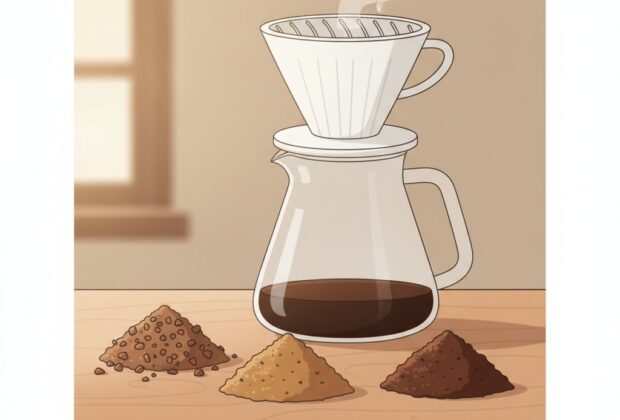
Why Grind Size Is the Most Important Variable in Pour-Over Brewing
If you've ever wondered why your pour-over coffee tastes sour one day and bitter the next despite using the same beans, grind size is often the culprit. Grind size determines how much surface area coffee grounds expose to water, which directly controls the rate of extraction. Get it right, and you unlock the sweet, balanced flavors hidden in your beans. Get it wrong, and even the finest single-origin coffee can taste flat or harsh.
As explored in our complete extraction guide, pour-over brewing is a delicate balance of variables working together. Grind size sits at the center of that balance because it interacts directly with water contact time and temperature.
The Science: Surface Area and Extraction Rate
Coffee extraction is essentially a process of dissolving soluble compounds out of ground coffee particles. Finer grounds have more exposed surface area relative to their volume, which means water can pull flavor compounds out faster. Coarser grounds have less surface area, slowing extraction down.
This matters enormously in pour-over brewing because the method typically only exposes coffee to water for two to four minutes. Compare that to cold brew, which steeps for hours. Because pour-over has such a short brew window, grind size becomes the primary lever for controlling how much flavor gets extracted in that limited time.
Under-Extraction vs. Over-Extraction
When grounds are too coarse for your brew time, water passes through too quickly and doesn't have enough contact time to dissolve the desirable compounds. This results in under-extraction, which tastes sour, thin, and salty.
When grounds are too fine, water struggles to pass through and lingers too long, pulling out excessive bitter and astringent compounds. This is over-extraction, and it often tastes harsh, dry, or hollow.
Recommended Grind Sizes by Brewing Method
Different pour-over devices have different flow rates based on their filter material, cone shape, and number of holes. This means the ideal grind size varies by brewer, even though the underlying principles stay the same.
Hario V60
The V60's large single hole and spiral ridges allow water to flow through quickly, so it typically performs best with a medium-fine grind, similar in texture to table salt. This grind size, combined with a controlled pour technique, gives baristas precise control over extraction time.
Chemex
The Chemex uses a much thicker paper filter that slows water flow considerably. To compensate, a medium-coarse grind, closer to the texture of coarse sea salt, is recommended. Using a finer grind with a Chemex often leads to clogging and prolonged brew times that result in bitterness.
Kalita Wave
The Kalita Wave's flat-bottomed design and three small holes create a more even, controlled flow. A medium grind works well here, sitting between the V60 and Chemex recommendations.
Troubleshooting Grind Size Based on Taste
Rather than memorizing exact settings, it's more useful to taste your coffee and adjust accordingly. Grind size adjustments should always be made in small increments, testing one change at a time.
- If your coffee tastes sour or weak: Try a finer grind to slow the flow and increase extraction.
- If your coffee tastes bitter or harsh: Try a coarser grind to speed up the flow and reduce extraction.
- If your total brew time is far outside the 2:30–4:00 minute range: Adjust grind size before changing anything else.
It's worth noting that water chemistry also plays a role in how extraction tastes, as discussed in our article on water chemistry's role in pour-over coffee taste. If you've dialed in your grind size but something still feels off, your water mineral content may be worth investigating next.
Investing in the Right Grinder
Consistency matters as much as the average grind size setting. Blade grinders produce uneven particle sizes, which means some grounds over-extract while others under-extract simultaneously, muddying flavor clarity. A quality burr grinder, whether manual or electric, produces uniform particles and is one of the best investments a pour-over enthusiast can make.
Final Thoughts
Mastering grind size is less about hitting a perfect number and more about understanding the relationship between particle size, water contact time, and flavor. Start with the recommended grind for your brewing method, taste critically, and adjust in small steps. With practice, dialing in grind size becomes second nature, and it's one of the most rewarding skills in home coffee brewing.