
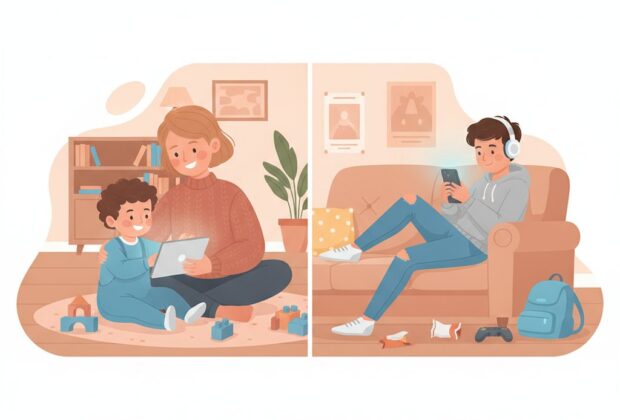
Why One-Size-Fits-All Screen Time Rules Don't Work
Ask two parents what "healthy screen time" looks like and you'll likely get two very different answers—and both could be right. A toddler navigating a tablet has fundamentally different developmental needs, cognitive capacities, and risks than a teenager scrolling through social media on a smartphone. Yet many families default to blanket rules like "two hours a day" without accounting for the dramatic shifts that occur across childhood and adolescence.
Understanding screen time toddlers vs teens dynamics isn't just an academic exercise. It shapes how parents set expectations, choose tools, and respond when conflicts arise. This guide walks through the developmental science, age-specific recommendations, and practical frameworks that can help any family build a screen time approach that evolves as children grow.
The Developmental Science Behind Age-Specific Screen Time
Brain development doesn't happen at a steady pace—it occurs in bursts, with different regions maturing at different rates. This matters enormously for screen time policy because a toddler's brain and a teenager's brain process digital content in completely different ways.
Toddlers: Building Foundational Skills
Between ages one and three, children are developing core skills through physical interaction with their environment—touching, manipulating, imitating facial expressions, and engaging in back-and-forth communication. Passive screen exposure during this window can displace these critical developmental activities. Research from pediatric associations consistently points to concerns about language delays, attention difficulties, and reduced face-to-face interaction time when screens dominate a toddler's day.
Toddlers also lack the cognitive architecture to understand that what happens on a screen isn't directly transferable to real life—a phenomenon researchers call the "video deficit effect." A toddler might struggle to apply a lesson learned from an educational app to a real-world situation, even though an older child would make that connection easily.
Teens: Navigating Identity and Independence
By adolescence, the brain has developed far more capacity for abstract thinking, self-regulation, and social reasoning—though the prefrontal cortex, responsible for impulse control and long-term planning, isn't fully mature until the mid-twenties. This creates a unique paradox: teens are cognitively sophisticated enough to use screens for genuine learning, social connection, and creative expression, but still vulnerable to compulsive use patterns, social comparison, and algorithm-driven content loops.
Unlike toddlers, teens use screens as an extension of their social and emotional lives. Digital spaces are where friendships are maintained, identities are explored, and peer status is negotiated. This makes screen time management far less about limiting exposure and more about guiding healthy digital citizenship.
Recommended Screen Time Limits by Age Group
While specific numbers should always be adapted to individual family circumstances, several general benchmarks are widely referenced by pediatric health organizations:
- Under 18-24 months: Avoid screen use except for video chatting with family members.
- 2-5 years: Limit to about one hour per day of high-quality, co-viewed programming.
- 6-12 years: Consistent limits that balance screen use with sleep, physical activity, and other healthy behaviors—often ranging from one to two hours of recreational screen time.
- 13-18 years: Less about strict hourly caps and more about ensuring screens don't interfere with sleep, in-person relationships, academic responsibilities, and mental well-being.
These numbers are starting points, not rigid mandates. A teenager using screens for homework, coding projects, or video editing is in a very different situation than one spending equivalent time passively scrolling. Context and content quality matter as much as duration.
Key Differences in Risk Profiles
The risks associated with screen time shift dramatically as children age, and understanding these differences helps parents prioritize their attention appropriately.
Risks Specific to Toddlers
For young children, the primary concerns center on displacement—screen time replacing activities essential for development, such as unstructured play, physical movement, and direct caregiver interaction. Overstimulation from fast-paced content can also affect attention regulation, while excessive exposure has been linked in some studies to delayed language acquisition when it substitutes for conversation with caregivers.
Sleep disruption is another significant concern, as blue light exposure and stimulating content close to bedtime can interfere with the sleep patterns toddlers need for healthy growth and cognitive development.
Risks Specific to Teens
Teenagers face a different set of challenges: social comparison and self-esteem issues linked to social media use, exposure to harmful content, cyberbullying, sleep disruption from late-night device use, and the compulsive design features built into many popular apps. Mental health researchers have increasingly focused on the relationship between heavy social media use and rising rates of anxiety and depression among adolescents, though the research remains nuanced and correlation doesn't always imply direct causation.
Unlike toddlers, teens also face privacy and safety risks tied to online interactions with strangers, data collection practices, and the permanence of digital footprints—concerns that require entirely different conversations and safeguards than those used with younger children.
Common Myths About Screen Time Across Ages
Several persistent myths complicate parental decision-making, and it's worth addressing them directly.
Myth: All Screen Time Is Equally Harmful
Not all screen time is created equal. Educational content co-viewed with a caregiver, video calls with distant relatives, and creative tools like digital art or music apps offer very different value than passive video consumption or algorithm-driven feeds. Quality and context matter as much as quantity, for both toddlers and teens.
Myth: Strict Limits Work the Same Way at Every Age
What functions as an effective boundary for a toddler—simple, consistent, externally enforced rules—often backfires with teenagers, who respond better to collaborative agreements and explanations of reasoning. Rigid enforcement without dialogue can push teens toward secrecy rather than healthy self-regulation.
Myth: More Screen Time Always Means Worse Outcomes
Duration alone is a poor predictor of harm. A teen spending three hours on collaborative coding projects or video editing for a creative hobby is having a very different experience than one spending three hours passively scrolling. Parents should evaluate the type of engagement, not just the clock.
Practical Frameworks for Managing Screen Time by Age
Rather than applying identical rules across all ages, effective families tend to use adaptable frameworks that scale in complexity as children mature.
For Toddlers: Structure and Co-Engagement
With young children, the most effective approach centers on structure, consistency, and shared experience. This means setting predictable times for screen use, choosing high-quality content in advance, and watching or interacting alongside the child whenever possible. Co-viewing transforms passive consumption into an interactive learning opportunity, since caregivers can ask questions, connect content to real life, and model engaged attention. For more detailed, actionable strategies specifically designed for this age group, dedicated toddler-focused guidance can offer step-by-step routines that actually hold up under real-world pressure.
For Teens: Collaboration and Digital Literacy
As children move into adolescence, the framework shifts from external control toward guided independence. This involves open conversations about why certain boundaries exist, collaborative rule-setting that gives teens a voice, and an emphasis on digital literacy—helping teens recognize manipulative design patterns, evaluate the credibility of online content, and understand the emotional effects of social comparison. Family agreements, rather than unilateral restrictions, tend to produce better long-term outcomes because they build the self-regulation skills teens will need once they leave the household. Detailed strategies for navigating this transition, including how to negotiate boundaries without constant conflict, are covered in dedicated resources focused specifically on teen digital habits.
Transitional Strategies for Middle Childhood
The years between early childhood and adolescence—roughly ages six to twelve—serve as a critical bridge. This is the ideal window to begin transferring responsibility gradually, introducing concepts like time management, content evaluation, and self-monitoring while parental oversight is still relatively close. Tools like shared family calendars for screen time, simple check-ins about online experiences, and incremental increases in independence help prepare children for the more autonomous digital lives they'll lead as teenagers.
Adapting Rules as Children Grow
One of the most common parenting mistakes is treating screen time rules as static rather than evolving. A framework that works for a five-year-old will almost certainly fail for a fifteen-year-old, not because the earlier approach was wrong, but because developmental needs have changed entirely.
Successful long-term management typically involves periodic reassessment—revisiting rules every six to twelve months, or whenever a major developmental milestone occurs, such as starting a new school, receiving a first personal device, or joining a new social platform. These moments offer natural opportunities to renegotiate expectations and ensure that rules remain relevant rather than becoming a source of ongoing friction.
It also helps to involve children increasingly in the rule-making process as they mature. A toddler obviously can't participate in setting their own screen time boundaries, but a ten-year-old can meaningfully contribute to a conversation about homework-versus-recreation balance, and a teenager should be an active partner in defining what healthy digital habits look like for their specific life and interests.
Signs a Screen Time Approach Needs Adjustment
Regardless of age, certain warning signs suggest that current screen habits need reevaluation. These include noticeable changes in mood tied to device use or removal, declining performance in school or other responsibilities, withdrawal from in-person relationships and activities previously enjoyed, disrupted sleep patterns, and resistance or secrecy around screen use that wasn't previously present. For toddlers, additional red flags include delayed speech milestones or difficulty engaging in unstructured play. For teens, signs might include anxiety specifically linked to social media notifications or an inability to disconnect even when asked.
Recognizing these signals early allows parents to intervene before habits become deeply entrenched, whether that means adjusting toddler routines toward more interactive play or opening a more serious conversation with a teenager about their relationship with a particular app or platform.
Building a Family Media Plan That Scales
Rather than reinventing screen time rules at every developmental stage, many families find success creating a broader family media plan that establishes core values—like protecting sleep, prioritizing in-person connection, and encouraging creative or educational use—while allowing specific rules to flex as children age. This approach keeps the underlying philosophy consistent even as the details change dramatically between the toddler years and adolescence.
A well-designed media plan typically addresses device-free zones and times, expectations around content types, guidelines for new technology introductions, and a clear process for revisiting the plan as circumstances change. When children see that rules stem from consistent family values rather than arbitrary restrictions, they're more likely to internalize healthy habits that persist even without direct supervision.
Final Thoughts
Managing screen time across childhood isn't about finding the perfect number of hours—it's about understanding how developmental needs, risks, and appropriate strategies shift dramatically between toddlerhood and adolescence. What works to protect a two-year-old's language development looks nothing like what supports a sixteen-year-old's healthy digital citizenship, and that's exactly as it should be. By grounding decisions in developmental science, staying alert to warning signs, and remaining willing to adapt rules as children grow, parents can build screen time approaches that genuinely serve their children at every stage.