
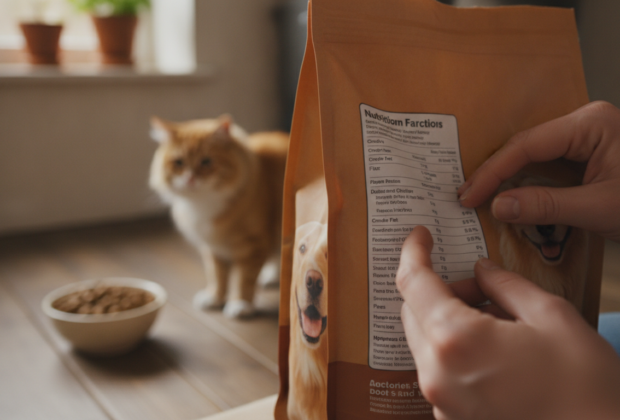
Walk down any pet food aisle and you'll find bags and cans covered in bold claims: "natural," "premium," "vet recommended," "made with real chicken." Yet flip the package over, and the actual label — the ingredient list, guaranteed analysis, and regulatory statements — tells a very different and far more useful story. Learning how to read pet food labels is one of the most valuable skills a pet owner can develop, because it cuts through marketing noise and gives you the real information you need to choose a food that supports your animal's health.
This guide walks through every major component of a pet food label, explains what the terms actually mean, and shows you how to compare products fairly across brands. Think of it as your foundational reference — we'll also point out where specific topics, like ingredient order or the guaranteed analysis panel, deserve a deeper dive.
Why Pet Food Labels Are Harder to Read Than They Look
Pet food packaging is designed by marketing teams, but the actual label content is governed by regulatory bodies — primarily state feed control officials who follow model standards set by the Association of American Feed Control Officials (AAFCO). This creates a split personality on every bag: the front of the package is persuasive and often vague, while the back is technical, regulated, and genuinely informative.
The challenge is that most shoppers only read the front. Understanding how to read pet food labels means training your eye to go straight to the back panel — the ingredient list, the guaranteed analysis, the nutritional adequacy statement, and the feeding guidelines — and treating the front-of-package claims with healthy skepticism.
The Ingredient List: Reading Order and Weight
By law, pet food ingredients must be listed in descending order by weight, as they go into the mixing bowl before cooking or processing. This single rule is the key to understanding most of what's on a label, but it also creates opportunities for clever formulation tricks.
How Weight Order Can Mislead
Ingredients are weighed before cooking, which means high-moisture ingredients like fresh chicken or beef appear heavier — and therefore higher on the list — than they will be in the finished product once water cooks out. A food might list "chicken" first, but after moisture loss, the actual contribution of that chicken by dry weight could be smaller than a dehydrated meat meal listed third or fourth. This is sometimes called "ingredient splitting" or the "moisture trick," and it's one of the most common sources of confusion for shoppers trying to compare protein content.
Ingredient Splitting
Manufacturers can also split a single ingredient category — like corn — into several forms (corn meal, corn gluten, ground corn) so that each form individually weighs less than the main protein source, even though the combined total of all corn-derived ingredients may outweigh it. This doesn't make corn inherently bad, but it does mean the ingredient list alone can create a misleading impression of a formula's composition if you only glance at the first one or two items.
For a full breakdown of how to interpret individual ingredients, names, and categories, a dedicated resource on decoding pet food ingredient lists explained is worth reviewing alongside this guide.
The Guaranteed Analysis: Minimums, Maximums, and What's Missing
Every pet food label includes a guaranteed analysis panel listing minimum percentages of crude protein and crude fat, and maximum percentages of crude fiber and moisture. This panel is required, standardized, and useful — but it is also frequently misunderstood.
The word "crude" refers to the laboratory testing method, not the quality of the ingredient. A high crude protein minimum tells you how much protein is present by this specific test, but it says nothing about the protein's digestibility, amino acid profile, or source. Two foods can have identical guaranteed protein minimums while differing enormously in actual nutritional value, because one uses highly digestible animal protein and the other relies on harder-to-digest plant protein to hit the same number.
Because these are minimums and maximums rather than exact values, and because moisture content varies dramatically between kibble, canned, and raw foods, comparing guaranteed analysis numbers directly across product types is misleading unless you convert them to a dry matter basis. A more detailed explanation of these calculations and what the numbers really mean is covered in a separate guide focused specifically on the guaranteed analysis panel.
AAFCO Statements: The Most Important Line You've Never Read
Tucked in small print near the ingredient list is the AAFCO nutritional adequacy statement, and it is arguably the single most important sentence on the entire package. It tells you whether the food is "complete and balanced" and for which life stage.
Types of AAFCO Statements
- Formulated to meet AAFCO nutrient profiles: The recipe was designed on paper to meet established nutrient levels for a specific life stage, based on nutrient analysis rather than live feeding trials.
- Animal feeding tests using AAFCO procedures substantiate that this product provides complete and balanced nutrition: The formula was actually tested on live animals over a defined period, which many nutritionists consider a stronger validation.
- For intermittent or supplemental feeding only: This is a critical phrase — it means the product is not nutritionally complete and should not serve as an animal's sole diet. Many toppers, mixers, and some wet food lines carry this statement.
The statement will also specify a life stage: growth (puppies/kittens), reproduction, adult maintenance, or "all life stages." A food labeled for "all life stages" is formulated to meet the more demanding requirements of growth and reproduction, which means it's generally higher in calories and certain minerals than a food labeled strictly for adult maintenance. Feeding an all-life-stages food to a sedentary adult dog without portion adjustment can contribute to weight gain.
Feeding Guidelines: A Starting Point, Not a Prescription
Every label includes a feeding guideline chart, typically organized by body weight, suggesting a daily amount. These figures are based on average activity levels and average-sized animals within a breed or weight range, which means they're a reasonable starting point but rarely an exact fit for your individual pet.
Factors like age, spay/neuter status, activity level, metabolism, and climate all affect caloric needs. A good practice is to start with the label's suggested amount, monitor your pet's body condition over several weeks, and adjust up or down by small increments. Feeding guidelines also tend to be generous because manufacturers would rather you use more of the product than less — another reason not to treat the printed number as absolute.
Common Marketing Terms and What They Legally Mean
Front-of-package language is often regulated far more loosely than the back panel, and some terms carry specific legal definitions that don't match consumer assumptions.
"Natural"
Under AAFCO guidelines, "natural" means the product contains no artificial flavors, colors, or preservatives, with a narrow exception for added synthetic vitamins and minerals. It does not mean organic, free of all processing, or inherently healthier.
"Premium," "Super Premium," and "Gourmet"
These terms carry no regulatory definition whatsoever. A bag labeled "premium" is not required to meet any different ingredient or nutrient standard than a budget-tier product sitting next to it on the shelf. These are purely marketing terms.
The "95%" and "25%" Rules
AAFCO has specific naming rules tied to ingredient percentage. If a product is named "Beef for Dogs," beef must make up at least 95% of the product (excluding water for processing). If it's named "Beef Dinner," "Beef Entrée," or "Beef Formula," the named ingredient only needs to make up 25% of the product. A "with Beef" claim requires only 3%, and a "Beef Flavor" product may contain no actual beef at all — just enough flavoring to be detectable. Learning to spot these naming conventions instantly changes how you read a front label.
"Grain-Free" and "Limited Ingredient"
Grain-free simply means no grains were used — it says nothing about overall quality and often means grains are replaced with other starches like peas, lentils, or potatoes. "Limited ingredient" has no legal definition either, though it generally signals a shorter ingredient list intended for pets with sensitivities.
How to Compare Brands Fairly
Because formats, moisture content, and marketing language vary so widely, a side-by-side comparison requires a consistent method rather than a glance at the front of the bag.
- Convert to dry matter basis when comparing wet and dry foods, since canned food's high moisture content makes its guaranteed analysis numbers look artificially low compared to kibble.
- Check the AAFCO statement first to confirm the food is complete and balanced for your pet's actual life stage.
- Read past the first three ingredients — look at the whole list, including whether multiple forms of the same ingredient (like several corn derivatives) appear throughout.
- Ignore front-of-package buzzwords like "premium" or "gourmet" and focus on the regulated panels instead.
- Compare calorie content per cup or can, not just by weight, since caloric density varies and affects how much you'll actually feed.
- Look at the manufacturer — contact information, a named nutritionist on staff, and transparency about sourcing and manufacturing are good signs, though they're not printed in a standardized panel.
Putting It All Together
Reading a pet food label well means resisting the pull of the front panel and going straight to the parts that are regulated and standardized: the ingredient list in descending weight order, the guaranteed analysis adjusted for moisture, the AAFCO nutritional adequacy statement confirming life-stage suitability, and the feeding guidelines as a flexible starting point rather than a fixed rule. Once you understand how these pieces fit together, marketing terms like "natural" or "premium" lose their power to mislead, and you can judge a food on its actual nutritional merits.
From here, it's worth going deeper into the two panels that cause the most confusion: the full ingredient list, covered in detail in our guide on decoding pet food ingredient lists, and the guaranteed analysis numbers, broken down further in our guide on what those figures really mean. Together, these resources will give you a complete, confident framework for choosing food based on substance rather than slogans.