
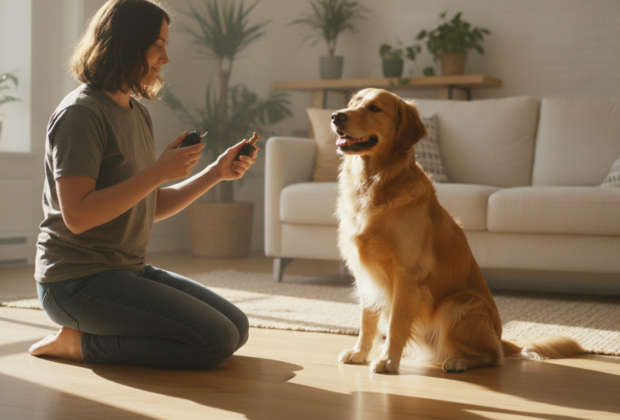
What Is Clicker Training?
Clicker training is a positive reinforcement method that uses a small handheld device to make a distinct "click" sound the instant your dog performs a desired behavior. That click acts as a marker, telling your dog exactly which action earned a reward. Because the sound is fast, consistent, and unmistakable, dogs learn to associate it with success much quicker than they would with verbal praise alone.
This technique fits neatly within the broader philosophy covered in our guide to Dog Training Basics: Positive Reinforcement Techniques That Actually Work, where timing and consistency are key to helping dogs understand what earns them rewards.
Why the Clicker Speeds Up Learning
Dogs live in the moment, so the gap between a behavior and its reward matters enormously. Even a two-second delay in delivering a treat can confuse your dog about which action you're actually reinforcing. A clicker solves this problem by marking the exact moment of success, even if the treat itself takes a few seconds to reach your dog's mouth.
Over time, this precision helps dogs make faster connections between actions and outcomes, which is why many trainers consider clicker training one of the most efficient tools for shaping new behaviors from scratch.
Step 1: Charging the Clicker
Before you can use the clicker to teach specific behaviors, your dog needs to understand that the click always predicts a reward. This process, known as "charging" the clicker, is simple:
- Click once, then immediately give your dog a small, high-value treat.
- Repeat this 10-15 times per session, without asking for any behavior.
- Do this over two or three short sessions until your dog perks up or looks for a treat the moment they hear the click.
Once your dog reliably associates the sound with a reward, you're ready to start shaping actual behaviors.
Step 2: Shaping Behaviors With the Clicker
Shaping involves clicking and rewarding small steps toward a final behavior. For example, if you're teaching "sit," you might click the moment your dog's hindquarters start to lower, rather than waiting for a full sit. As training progresses, you gradually raise your criteria, clicking only for behaviors that are closer to the final goal.
Keep sessions short, ideally five to ten minutes, so your dog stays engaged and doesn't lose interest. Always click at the exact moment the behavior happens, then follow with a treat within a second or two.
Step 3: Phasing Out the Clicker
The clicker is a teaching tool, not a permanent fixture. Once your dog reliably performs a behavior on cue, you can start transitioning to verbal praise or intermittent rewards instead of clicking every single time. A common approach is to click and reward every other successful repetition, then gradually stretch out the intervals until the clicker is no longer needed for that specific behavior.
Many trainers keep the clicker in their toolkit for teaching new skills, even after phasing it out for behaviors the dog has already mastered.
Common Beginner Mistakes to Avoid
- Clicking too late: If you click after the behavior has ended, your dog may associate the reward with the wrong action.
- Forgetting to reward after every click: The click must always be followed by a treat, or your dog will stop trusting the sound.
- Using the clicker as a command: The clicker marks behavior, it doesn't ask for it. Use verbal cues or hand signals to prompt actions, and the clicker only to confirm success.
- Overusing it in noisy environments: In distracting settings, your dog may struggle to connect the sound with their action. Start training in quiet spaces before adding distractions.
Clicker Training vs. Verbal Marker Training
Some trainers prefer using a verbal marker word, like "yes," instead of a mechanical clicker. Both methods rely on the same principle: marking the exact moment of a correct behavior. Here's how they compare:
- Precision: A clicker produces a consistent, unique sound every time, while a verbal marker can vary slightly in tone or timing depending on your voice.
- Convenience: Verbal markers don't require carrying a device, making them easier to use spontaneously throughout the day.
- Learning speed: Many trainers find dogs pick up the clicker's distinct sound faster since it's not mixed in with everyday speech.
- Best use case: Clickers are often ideal for teaching brand-new, complex behaviors, while verbal markers work well for reinforcing behaviors your dog already knows.
Ultimately, the best choice depends on your lifestyle and your dog's learning style. Some trainers even use both, starting with a clicker for new skills and transitioning to verbal markers for everyday reinforcement.
Bringing It All Together
Clicker training is a powerful, science-backed method for teaching dogs faster and more precisely. By charging the clicker properly, shaping behaviors in small steps, and gradually phasing out the tool once behaviors are learned, you can build a strong training foundation. If you're also dealing with problem behaviors alongside teaching new skills, check out our companion guide on How to Stop Unwanted Dog Behaviors Using Positive Reinforcement (No Punishment Needed) for practical, reward-based solutions.