
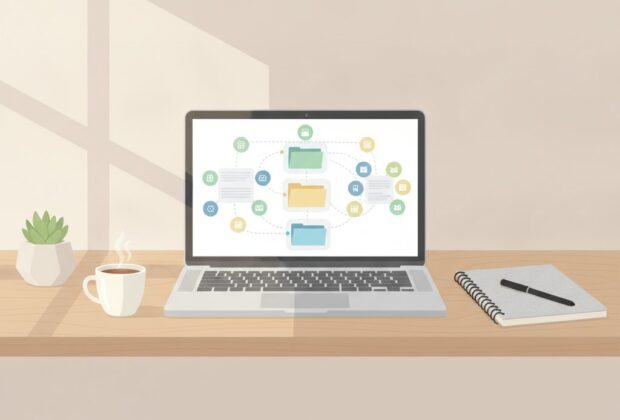
What Is Async-First Personal Knowledge Management?
Async-first personal knowledge management (PKM) is an approach to capturing, organizing, and retrieving information that doesn't depend on real-time note-taking or immediate processing. Instead of scrambling to organize a thought the moment it appears, you capture it quickly and process it later, on your own schedule. This philosophy borrows heavily from asynchronous communication practices in remote work, applying the same principle to how we manage our own knowledge: capture now, think later.
For knowledge workers juggling meetings, projects, and constant digital noise, an async-first system reduces the pressure to make perfect decisions in the moment. It creates breathing room between input and organization, which leads to better long-term thinking.
Why Async Beats Real-Time Note-Taking
Real-time note-taking habits often force you to categorize, tag, and file information the instant you receive it. This creates unnecessary cognitive load, especially when you're in the middle of a meeting or deep work session. Async-first PKM separates capture from processing, allowing your brain to stay focused on the task at hand while trusting that a later review session will handle the organization.
This approach also produces higher-quality notes. When you revisit captured ideas with fresh eyes, you naturally connect them to existing knowledge, spot patterns, and discard what's no longer relevant. As explored in our guide to async capture workflows for knowledge workers, the quality of your capture habits sets the foundation for everything downstream.
The Four Core Principles
Capture
Capture is about getting information out of your head and into a trusted system as fast as possible, without judgment or categorization. The goal is speed and low friction, not perfection.
Process
Processing happens later, in dedicated sessions where you review what you've captured and decide what deserves further attention, archiving, or action.
Organize
Once processed, information needs a home. Many async-first practitioners rely on frameworks like PARA or Zettelkasten, adapted for asynchronous workflows, to keep notes discoverable and connected over time.
Retrieve
A knowledge system is only useful if you can find what you need when you need it. Strong retrieval depends on consistent tagging, linking, and periodic review rather than relying on memory alone.
Choosing the Right Tools
Async-first PKM doesn't require a single perfect app—it requires a stack that supports quick capture, flexible organization, and reliable search. Common tool categories include quick-capture apps for mobile and desktop, note-taking platforms with linking capabilities, and task managers that integrate with your knowledge base. Our roundup of the best tools for async note-taking in 2024 covers specific options in more depth.
How Async Thinking Reduces Cognitive Load
By decoupling capture from organization, async-first PKM frees up mental bandwidth throughout the day. You're no longer holding onto half-formed thoughts, worrying about where to file them, or interrupting deep work to tidy up your notes. Instead, you trust the system, capture quickly, and schedule dedicated time to process everything at once.
This rhythm mirrors best practices in remote and distributed teams, where async communication reduces the pressure to respond immediately. Applied to personal knowledge management, it results in calmer, more intentional thinking.
Building Your Workflow
A simple async-first workflow typically includes a quick-capture tool for fleeting thoughts, a regular processing session (often weekly) to review and organize captured material, and an organizational structure that supports easy retrieval. Our guide to weekly review rituals for async knowledge systems offers a practical template for this recurring habit, while our piece on automating your async PKM with scripts and APIs shows how to reduce manual effort further.
Getting Started
If you're new to async-first PKM, start small. Pick one capture tool, commit to a weekly review, and choose a lightweight organizational method like PARA. As your habits solidify, you can layer in more advanced techniques from the other guides in this series to build a system that scales with your work and thinking.